

Lode Hybrid Park
Lode Hybrid Park is a cross-border project planned to be developed in phases along the Latvian-Estonian border by Utilitas Wind.
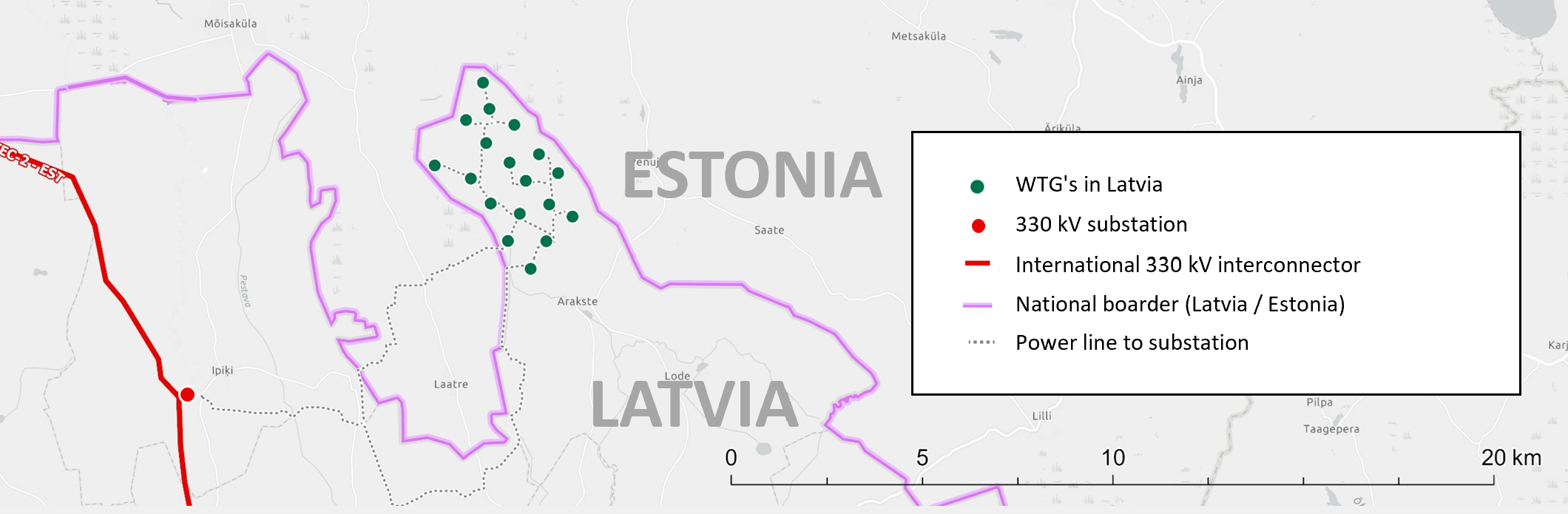
Lode Hybrid Park is a cross-border project planned to be developed in phases along the Latvian-Estonian border by Utilitas Wind. The first phase of the park comprises 18 Vestas V162-6.5 MW wind turbines – is planned approximately 4 km north-west of the village of Lode in Valmiera Municipality, and these will be connected to the Latvian transmission grid alongside a 60 MW/240 MW battery storage facility adjacent to the Ipiķi substation.
Co-financing
The project has received funding under the energy programme of the Connecting Europe Facility (CEF) for cross-border renewable energy projects.
CEF funding under Action No. 2023-2-EU-W-M-23-ULP-RES WP is being used for the grid connection infrastructure, substations, internal power supply infrastructure, roads and turbine foundations.
CEF funding under Action No. 2023-2-EU-W-M-25-ULP-RES WP is being used for the supply, installation, testing and commissioning of the wind turbines.
Funded by the European Union. Views and opinions expressed are however those of the author(s) only and do not necessarily reflect those of the European Union or The European Climate, Environment and Infrastructure Executive Agency. Neither the European Union nor the granting authority can be held responsible for them.

The hybrid wind farm in figures
330 kV Connection to the “Ipiķi” substation on the Latvia–Estonia 330 kV interconnector
60 MW / 240 MWh Energy storage system
330 GWh Planned annual electricity generation, which is approximately the annual consumption of 110,000 households
spring 2028 Planned commissioning

| Role | Company |
|---|---|
| Developer | Utilitas Wind (Lode Wind SIA) |
| Main contractor — roads, sites, foundations, electrical networks | PS AVC Partners — Verston OÜ, Aimasa SIA, Connecto Latvija SIA |
| Supply and installation of wind turbines | Vestas |
| Energy storage system | Hovmiles / C3 |
| Construction of the 330 kV ‘Ipiki’ substation | PS AVC Partners — Verston OÜ, Aimasa SIA, Connecto Latvija SIA |
| Construction supervision | Forma 2 |
Construction schedule
Start of works – August 2026
Setting up the construction site: fencing off the area, mobilising machinery, and installing of temporary traffic signs. The first lorries and construction machinery will appear in the area.
Construction of roads and sites – August 2026 to November 2027
Construction of internal roads within the wind farm and turbine assembly areas at each turbine location. This is the busiest period for material deliveries. Materials for the construction of the Lode wind farm will be delivered from both Estonia and Latvia. On the Estonian side, transport mainly uses the secondary road 24201, and on the Latvian side, national roads V176 and V177.
Foundation works – 4th quarter of 2026
Construction of reinforced concrete foundations for each wind turbine. Most of the concrete is made on site at the construction site, and a small part is delivered from the Valmiera plant if necessary.
Construction of cable connections and the 330 kV Ipiki substation –September 2026 to September 2027
Installation of 33 kV underground cable lines connecting the wind turbines to the substation and construction of the 330 kV Ipiķi substation on the Estonia–Latvia 330 kV interconnection.
Installation of batteries – 2nd quarter of 2027
Supply and installation of a 60 MW / 240 MWh battery energy storage system (BESS). The BESS will be installed in a fenced-off area next to the substation.
Delivery of wind farm components – June to September 2027
Tower sections, blades and nacelles will be delivered from the Port of Paldiski in Estonia. Deliveries will take place several times a week at night or in the early morning to minimise distruption to traffic.
Wind turbine assembly – July to October 2027
Crane operations at each wind turbine installation site: installation of tower sections, nacelles and blades.
Frequently Asked Questions

About wind energy in general
We can, but importing electricity means depending on neighbouring markets and their price swings. Latvia still imports nearly 19% of the electricity it consumes, and since the Baltic states disconnected from the Russian power grid, domestic generation is important for energy security. In Latvia the wind blows strongest in autumn and winter — exactly when consumption is highest and panels produce the least. Wind energy also helps balance the seasonal variations in Latvia’s hydropower generation, making it an excellent complement to the country’s energy portfolio.
Modern turbines are designed to last for 30 years and, and with regular maintenance their lifespan can be extended even more. At the end of a turbine’s life cycle, most of its materials can be recycled.
Fun fact: in roughly six months of operation, a turbine can produce as much energy as is used to manufacture, install and dismantle it. For the rest of its life cycle, it keeps contributing to energy production.

Hybrid park Lode
Wind farms are built in areas where there is enough wind, where they can be connected to the grid, and where they don’t have a negative impact on nature, biodiversity or the local living environment. Wind farm development involves extensive environmental studies and monitoring, both when potential turbine locations are being assessed and later during construction and operation.
In Lode, all of these conditions are met. The wind farm does not have a negative impact on nature or the environment, and lidar wind measurements from March 2023 to April 2024 confirmed a sufficient wind resource. The flat agricultural landscape allows the turbines to be placed well away from homesteads, and the Latvia–Estonia 330 kV interconnector is nearby, so the electricity produced can be fed into the grid without the major grid reinforcement.
Construction materials for the roads and wind turbine foundations will be transported from Latvian and Estonian quarries. The turbines will come from Paldiski Port and travel through Estonia. In Latvia, material deliveries run along state roads V176 and V177. The transport routes have been agreed with VSIA “Latvijas Valsts ceļi” (Latvian State Roads). On Estonian side, transport mainly uses the secondary road 24201. Inside the park, new service roads and assembly hardstands are being built. Wherever possible, we use and reinforce the existing road network. The contractor is responsible for maintaining the roads used during construction period. Once the works are completed, the roads will be restored to a condition no worse than the original.
Materials will be delivered only on working days, from 8.00 to 19.00. No material loads will be transported at night, on weekends or on public holidays. The only exception will be oversized turbine loads in the summer of 2027. They will move at night for safety reasons and we will inform local communities about them in advance.
The turbines at Lode wind farm are model Vestas V162-6.5 MW from the EnVentus platform. Their tower height is 166 meters, rotor diameter, which is the rotating part of the turbine, is 162 meters, and a total height with the blade in a vertical position is approximately 247 metres.
The park’s internal connections will use 33 kV underground cables, so no overhead lines will be used between the turbines. To connect the wind farm to the grid, a new 330 kV Ipiķi substation will be built next to the existing Latvia–Estonia interconnector, so no major grid reinforcement is necessary.

Benefits for the local area
All eligible households located within 2 km radius of a wind turbine, whether in Latvia or Because the turbines are located in Latvia, the payments will be made according to Latvian law. More specifically, Cabinet of Ministers Regulation No. 577 of 27 August 2024, which provides that the local community receives 2,500 euros per installed megawatt every year. For Lode wind farm, this amounts to approximately 292,500 euros a year. Up to 50% of this amount will go to households living within a 2-kilometre radius of a wind turbine, with the annual payment ranging from one to three minimum monthly wages. For example, in 2026, the minimum monthly wage in Latvia is 780 euros. The rest will go to the municipal budget. The regulation provides one exception: if a household already receives a payment for a wind turbine located on its property, it is not entitled to the additional support payment.
Although the law only requires payments to households in Latvia, at Utilitas Wind we believe that households on both sides of the border should be treated equally. We will therefore also pay compensation to households in Estonia that are within a 2-kilometre radius of a wind turbine, calculated on the same basis as under Latvian law. Because these payments are voluntary, we can extend them to households in Estonia, but not to the local Estonian municipality.
We will inform all households near the wind farm about how to apply for the payments well in advance. The payments will become available once the wind farm is commissioned, and we will publish the application procedure as soon as it has been approved by the municipality.
Your electricity bill depends on the market price of electricity and your contract with your electricity supplier. Living near a wind farm does not affect it. However, new wind farms bring more lower-cost electricity to the market, helping to reduce electricity prices and consumers’ electricity bills. The most direct financial benefit local residents will feel, will be the payments made to households and in the case of Latvian side, also the local municipality.

Environment, health and safety
The main noise source from modern turbines is the aerodynamic sound of the blades. Mechanical noise is audible only right next to a turbine. Experience and measurements show that at a distance of around 400–700 metres, noise levels remain below the regulatory limits even under the most conservative assumptions. The exact distance depends on the combined noise from several turbines, their layout, the surrounding terrain and other site-specific conditions.
Wind conditions also affect how turbine noise is perceived. As wind speeds increase, natural background noise becomes louder. For example, at wind speeds of around 8–10 m/s, the sound of wind in trees and other vegetation can largely cover the sound of the turbines.
Before construction, noise is modelled using an internationally recognized methodology (ISO 9613-2). The model deliberately assumes the worst-case situation, as if the wind were blowing from the turbine towards every house at the same time. This means that actual noise levels are usually lower than modelled. Once the park is in operation, we will carry out noise measurements at the nearest residential properties and report the results to the relevant authorities.
Scientific research to date does not indicate that turbine noise, infrasound, shadow flicker or electromagnetic fields at the regulatory distances are harmful to health. Infrasound is produced both by nature (wind, the sea) and by technology (transport).
In 2025, researchers at the University of Tartu carried out an extensive review of the best available studies on the health effects of wind farms. None of the studies found that infrasound from wind turbines had a harmful effect on health.
Measurements at wind farms, including an extensive Finnish state study published in 2020, find turbine-generated infrasound to be at background levels, below the threshold of human perception, and has not been linked to harmful health effects.
In clear weather, rotating blades can cast a moving shadow when the sun, the turbine and the observer line up, most often in the morning and evening. At our latitude the shadow never falls to the south of a turbine. Shadow flicker can be calculated precisely at the planning stage, and in practice does not cause noticeable disturbance beyond approximately 10 rotor diameters. In Lode’s case, this means up to 1.6 kilometres from a turbine. If shadow flicker at a nearby home exceeds the permitted limit of 8 hours per year, the wind park’s automatic control system will temporarily stop the relevant turbine.
Icing can occur in Latvia during the winter. The turbines have ice detectors that automatically stop the turbine if ice forms on the blades. The maintenance team will then remove the ice and restart the turbine. The risk of falling ice therefore exists mainly in the immediate vicinity of a turbine, where we ask people not to stay during icy conditions. Warning signs for visitors will be installed near the turbines.
There is a fire risk with any equipment, but for wind turbines it is low. The turbines’ external structures are made of steel, the equipment is monitored around the clock by automated systems that detect any irregularities early.
The turbine nacelles are fitted with automatic fire-suppression systems that rapidly release inert gases, displacing oxygen and suppressing the fire. The BESS containers have their own autonomous monitoring and fire-suppression system and they are in a fenced-off area away from buildings. An emergency response plan has been prepared and coordinated with the State Fire and Rescue Service (VUGD).
Studies do not give a clear answer to this question, and the impact on property values near similar projects has varied. Because households near the wind farm receive payments from the developer, owning such property can bring a direct financial benefit. In addition, the annual targeted payment to the Valmiera municipal budget, which must be invested in developing the local area, can significantly improve living conditions in the neighbourhood and thereby have a positive effect on property values.
Dismantling the wind farm is the park owner’s responsibility, and the costs are already taken into account during the development of the project. Most parts of a dismantled turbine, including the tower, generator, gearbox and foundations, are recycled. For the blades, which historically were harder to recycle, manufacturers (including Vestas) have introduced technologies for breaking composite materials down for reuse. In the summer of 2026, a wind turbine at the Grobiņa wind park operated by Utilitas Wind was dismantled and fully recycled. This shows that wind turbine dismantling and recycling is possible in Latvia as well.

You can share your views at any time through the feedback form, by e-mail, or by contacting the project manager. We register every submission and reply within 2 working days.
Please report any problem you notice to the project team or the contractor. Every report is registered and you will receive confirmation within 24 hours and a substantive reply within 2 working days. In an emergency, please call 112 first and then the project manager.


