

District heating
District heating based on renewable energy is the most convenient and environmentally friendly heating method in an urban environment that ensures year-round heating service and cleaner air in the cities.
Benefits of district heating
Environmentally
friendly
We produce most of our heat from renewable sources , we have low emissions of greenhouse gases and other pollutants, and we use all resources efficiently.
Easy
to use
District heating is easy to use – clients do not have to worry about maintenance, buying fuel, or setting up boilers.
Always
available
Thanks to Utilitas’ modern heating network and heating sources, consumers can be sure that their water and radiators will be warm whenever needed.
Future-
proof
Innovative heat production technologies can be added to the district heating network, which ensures the sustainability and reliability of the district heating also in for the future.
The most preferred heating method
District heating is the most common type of heating in Estonia. Its share in the heat supply is at least 60%. In Estonia, heat is consumed for at least eight months of the year, and at twice the volume of electricity. District heating is also the preferred choice in Nordic cities – in Copenhagen, over 95% of buildings use district heating, in Helsinki over 90%, and in Stockholm over 70%.
Our district heating clients
District heating is the most common type of heating in Estonia, its share in the heat supply reaches at least 60%, while a third of all district heating users in Estonia are clients of Utilitas.
65%
residential
buildings
21%
business
clients
14%
governmental and
municipal institutions
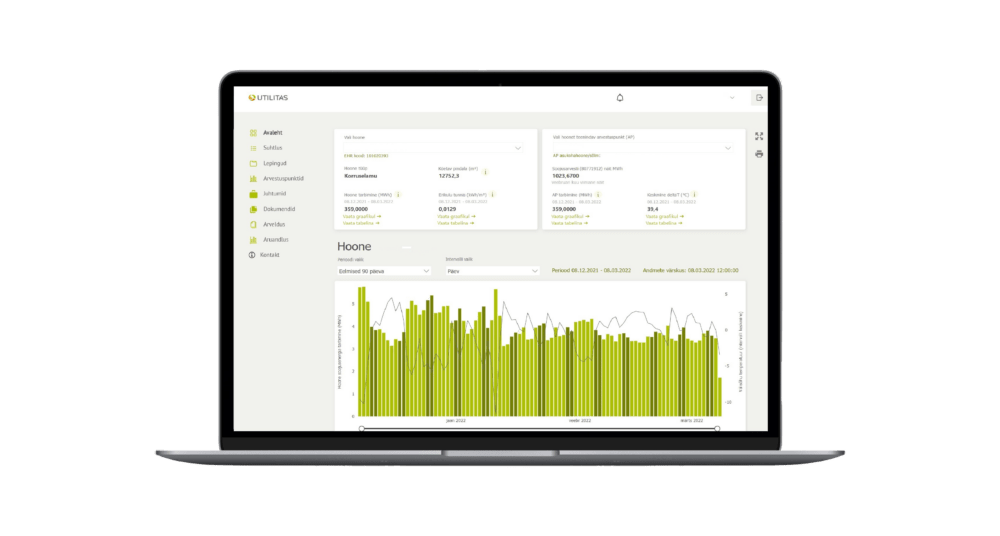
All Utilitas clients are connected to a convenient remote-reading system
Thanks to this, clients can always monitor their heat consumption via e-service portal and compare it with other similar buildings. The data helps Utilitas ensure the uninterrupted operation of the heating network.

Utilitas district heating systems can be recognized by their efficient district heating label
All Utilitas district heating systems are efficient as per European Union Energy Efficiency Directive 2023/1791/EL. A district heating network is efficient if it uses at least 50% renewable energy, 50% waste heat, 75% cogenerated heat, or 50% of a combination of such energy and heat.
The journey of district heating to the building

- A boiler house or cogeneration plant produces heat, which is used to heat buildings and the domestic water of consumers.
- Hot water is pumped through the pipeline from the boiler house to the heating substation of the client’s building.
- Hot water supplies heat through heat exchangers to radiators and/or underfloor heating and heats domestic water.
- Once the water has given away its heat, it then returns to the boiler house or cogeneration plant, where it is reheated.
Joining district heating

Every new building or building that has previously used another heating method and is located near the district heating network can be connected to the Utilitas district heating service.
If the district heating network is further away from your building, Utilitas joining the network may still be an option, the interest of potential clients is an important input for our network expansion plans.
Ask for additional information on connecting to district heatingThe process of connecting to the district heating service
The potential client is interested in the district heating service and contacts Utilitas.
We discuss the possibilities of joining, and sign an agreement.
A heating pipeline is designed and built.
A heating substation and a heat meter are designed and installed in the building.
The client signs a purchase-sale agreement for heat supply and starts using the district heating service from Utilitas.
District heating by Utilitas in Estonian cities
 77%
share of renewable energy and waste heat
77%
share of renewable energy and waste heat
 19.6 mln m²
area of heated buildings
19.6 mln m²
area of heated buildings
 4 950
heated buildings
4 950
heated buildings
 536 km
of district heating networks
536 km
of district heating networks
 11.6%
district heating network relative heat losses
11.6%
district heating network relative heat losses
 3.8 MWh/m
heat network density
3.8 MWh/m
heat network density
Data as of 31.12.2025
| 2023 | 2024 | 2025 | |
|---|---|---|---|
| Share of renewable energy and waste heat | 68.5% | 70.2% | 76.6% |
| of which renewable energy | 55.3% | 57.7% | 64.6% |
| Share of cogenerated heat | 58.8% | 67% | 67.7% |
| Energy source for heat production | 2023 | 2024 | 2025 |
|---|---|---|---|
| Wood chips | 47.6% | 49.4% | 54.1% |
| Renewable heat from municipal waste | 7.1% | 6.8% | 6.7% |
| Waste heat | 13.2% | 12.5% | 12% |
| Landfill gas | 0.1% | – | – |
| Renewable electricity | 0.5% | 1.5% | 3.8% |
| Natural gas | 27.7% | 29.7% | 23.4% |
| Shale oil | 3.6% | – | – |
| Light fuel oil | 0.2% | 0.1% | 0.1% |
89%
share of renewable energy
 441 th. m²
area of heated buildings
192
heated buildings
19 km
of district heating networks
11%
district heating network relative heat losses
2.5 MWh/m
heat network density
441 th. m²
area of heated buildings
192
heated buildings
19 km
of district heating networks
11%
district heating network relative heat losses
2.5 MWh/m
heat network density
Data as of 31.12.2025
| Year | Renewable energy | Wood chips | Natural gas | Shale oil |
|---|---|---|---|---|
| 2023 | 94.9% | 94.9% | 3.6% | 1.5% |
| 2024 | 88.7% | 88.7% | 10.6% | 0.6% |
| 2025 | 89.2% | 89.2% | 10.1% | 0.7% |
86%
share of renewable energy and waste heat
401 th. m²
area of heated buildings
239
heated buildings
21 km
of district heating networks
9.8%
district heating network relative heat losses
2.4 MWh/m
heat network density
Data as of 31.12.2025
| Year | Renewable energy | Wood chips | Shale oil |
|---|---|---|---|
| 2023 | 72.9% | 72.9% | 27.1% |
| 2024 | 77.9% | 77.9% | 22.1% |
| 2025 | 86.1% | 86.1% | 13.9% |
100%
share of renewable energy
85 th. m²
area of heated buildings
58
heated buildings
6 km
of district heating networks
14.9%
district heating network relative heat losses
1.2 MWh/m
heat network density
Data as of 31.12.2025
| Year | Renewable energy | Wood chips | Shale oil | Light fuel oil |
|---|---|---|---|---|
| 2023 | 99.9% | 99.9% | 0.1% | – |
| 2024 | 99.0% | 99.0% | 1.0% | – |
| 2025 | 99.7% | 99.7% | 0.2% | 0.1% |
95%
share of renewable energy
214 th. m²
area of heated buildings
108
heated buildings
13 km
of district heating networks
15.6%
district heating network relative heat losses
1.4 MWh/m
heat network density
Data as of 31.12.2025
| Year | Renewable energy | Wood chips | Natural gas |
|---|---|---|---|
| 2023 | 94.7% | 94.7% | 5.3% |
| 2024 | 97.8% | 97.8% | 2.2% |
| 2025 | 95.5% | 95.5% | 4.5% |
88%
share of renewable energy
207 th. m²
area of heated buildings
89
heated buildings
9 km
of district heating networks
12.5%
district heating network relative heat losses
2.3 MWh/m
heat network density
Data as of 31.12.2025
| Year | Renewable energy | Wood chips | Natural gas |
|---|---|---|---|
| 2023 | 81.6% | 81.6% | 18.4% |
| 2024 | 87.5% | 87.5% | 12.5% |
| 2025 | 88.4% | 88.4% | 11.6% |
91%
share of renewable energy
384 th. m²
area of heated buildings
197
heated buildings
20 km
of district heating networks
10.4%
district heating network relative heat losses
2.4 MWh/m
heat network density
Data as of 31.12.2025
| Year | Renewable energy | Wood chips | Shale oil |
|---|---|---|---|
| 2023 | 93.5% | 93.5% | 6.5% |
| 2024 | 85.0% | 85.0% | 15.0% |
| 2025 | 90.7% | 90.7% | 9.3% |
99%
share of renewable energy
412 th. m²
area of heated buildings
225
heated buildings
21 km
of district heating networks
16.1%
district heating network relative heat losses
2.1 MWh/m
heat network density
Data as of 31.12.2025
| Year | Renewable energy | Cogenerated heat | Wood chips | Natural gas | Light fuel oil |
|---|---|---|---|---|---|
| 2024 | 98.1% | 77.6% | 98.1% | 0.7% | 1.2% |
| 2025 | 99.1% | 75.5% | 99.1% | – | 0.9% |


